



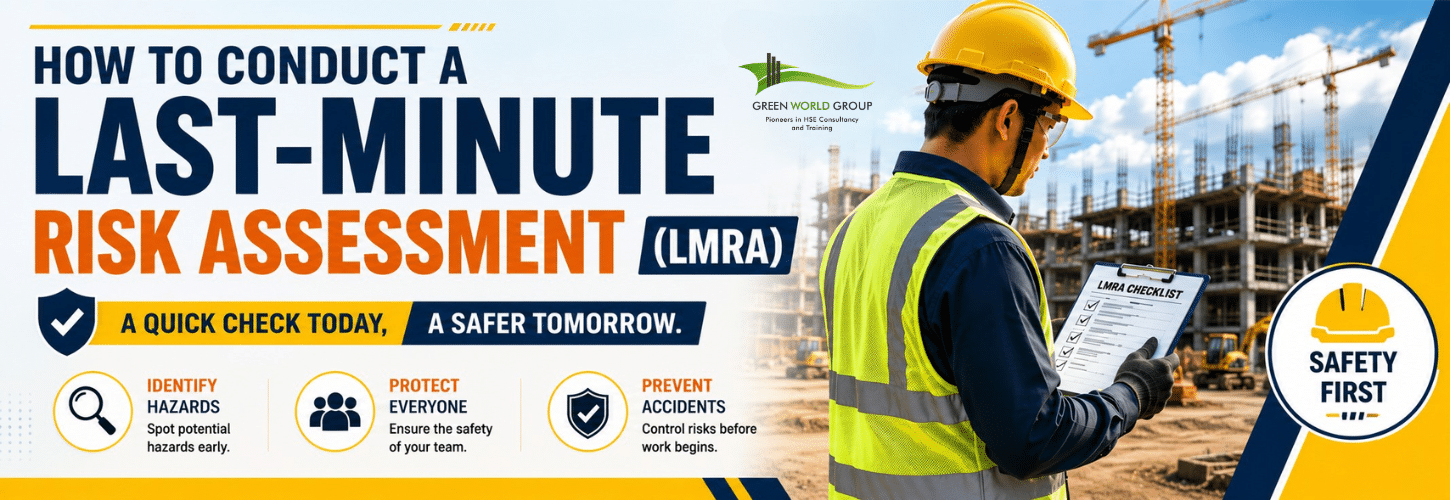
Introduction: Last Minute Risk Assessment
A maintenance technician arrived at a pump station to replace a faulty valve. The Job Safety Analysis was done. The Permit to Work was signed. The toolbox talk was completed that morning. Everything looked right on paper.
But conditions changed between the toolbox talk and the start of the job. A light drizzle had made the metal grating slippery. Tools had been left by a co-worker near the work area. And while the isolation tag was in place, the adjacent line was still live.
None of this was in the Job Safety Analysis. None of them were flagged in the Permit to Work.
The worker stepped forward, slipped, and fractured his wrist.
This is not a failure of the JSA. It is not a failure of the PTW.
It is a failure of the last-minute check — the LMRA.
What is LMRA and Why it is important
Last-Minute Risk Assessment (LMRA) is a personal, real-time hazard check performed by the worker themselves, immediately before starting a task. Not the supervisor. Not the safety officer. The worker.
It takes 2 to 5 minutes. It costs nothing. And when done honestly, it is the single most effective tool for catching hazards that no JSA or permit could have predicted.
Yet in most organizations, it is either rushed, skipped, or reduced to a signature on a form. That gap is exactly where incidents happen — and that is why LMRA is not optional. It is the difference between a planned task and an unplanned fatality.
Workplaces in 2026 are changing faster than ever. A risk assessment completed at 6:00 AM may no longer reflect the actual conditions by 10:00 AM. That’s where LMRA becomes important — it helps close the gap between planned safety procedures and what is really happening at the worksite in that moment.
What is the Difference Between HIRA, JSA, Toolbox Talk, and LMRA?
| Tool | When | Done By | Purpose |
|---|---|---|---|
| HIRA / Risk Assessment | Planning stage | HSE team | Identify hazards for the job type |
| JSA / JHA | Pre-task | Supervisor + team | Analyze steps and controls |
| Toolbox Talk | Start of shift | Supervisor | Communicate hazards to the crew |
| LMRA | Immediately before task | The worker | Verify real-time site conditions |
The Job Safety Analysis or Job Hazard Analysis (JSA/JHA) tells you what could go wrong. The LMRA tells you what is going wrong — right now, right here.
What Are the Key Benefits of Conducting LMRA?
When practiced consistently, LMRA delivers measurable value beyond hazard identification:
 Prevents incidents at the point of work — catches hazards that formal risk assessments cannot predict due to changing site conditions
- Empowers workers — puts safety ownership directly in the hands of the person doing the task, not just management
- Reduces routine blindness — stops workers from overlooking familiar hazards on tasks they have done many times before
- Strengthens stop-work culture — gives workers a structured reason to pause, question, and escalate without fear.
- Supports permit to work compliance — acts as the final real-time verification that site conditions match the permit
- Improves incident reporting — hazards found during LMRA become near-miss reports, building a stronger leading indicator culture.
 Prevents incidents at the point of work — catches hazards that formal risk assessments cannot predict due to changing site conditions
What Are the 5 Steps of LMRA — And How Do You Do Each One Correctly?
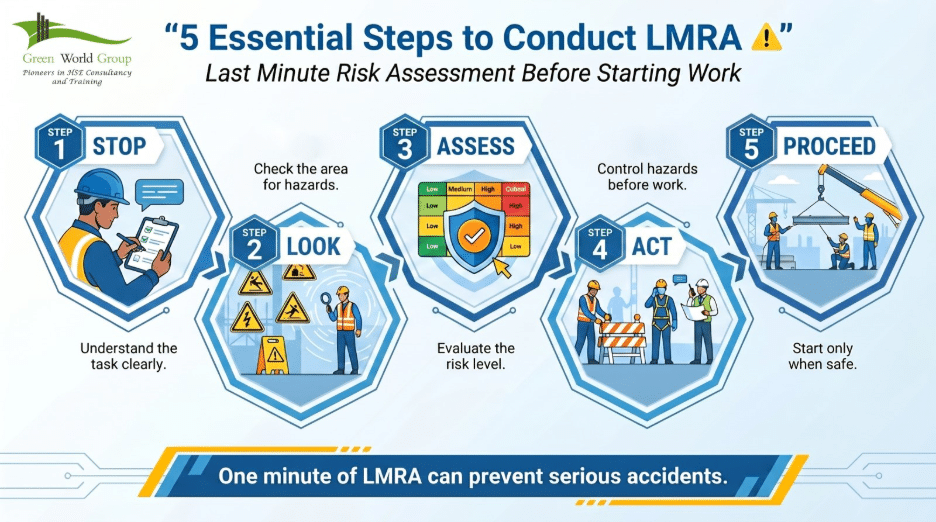
Step 1 — STOP: Do I Fully Understand the Task?
Before identifying any hazard, be completely clear on every step of the task. If anything is unclear or different from the original plan, stop and clarify with the supervisor before proceeding.
Step 2 — LOOK: What Hazards Are Present Right Now?
Physically walk the work area. Check energy isolation, surface conditions, overhead hazards, simultaneous operations, and whether unauthorized persons are present. Do not rely on memory or a previous check.
Step 3 — ASSESS: What is the Actual Risk Level Right Now?
For each hazard identified, ask: How likely is harm? How severe would the outcome be? Are the controls in the JSA and permit still valid for what you are seeing on the ground today?
Step 4 — ACT: What Must Be Done Before I Start?
If you spot a hazard, take action right away. Add a control to manage it, ask for the work to be re-isolated, or let your supervisor know. Never try to work around a hazard you can’t handle yourself.
Step 5 — Proceed: Is everything around here safe?
After a proper risk assessment, confirm that the area is completely risk free and safe for all personnel involved. Once all safety measures and precautions have been verified, proceed with the work.
What Does an LMRA Checklist Look Like in the Field?
An LMRA checklist helps identify hazards, assess risks, and verify safety controls before work begins. The image below shows an example of a practical LMRA checklist used to help workers perform a quick and effective Last Minute Risk Assessment for a safer work environment.
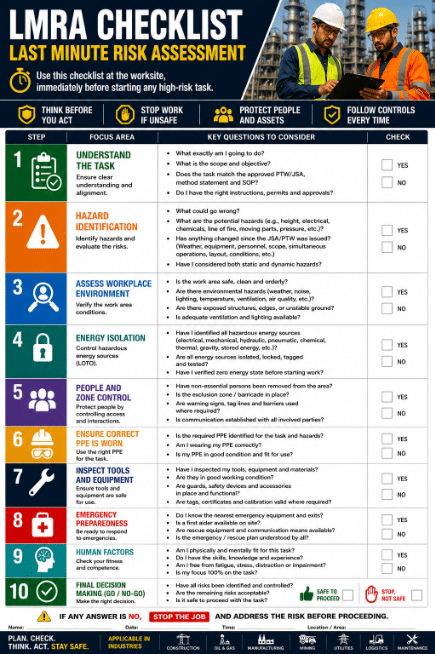
Use this checklist at the worksite, immediately before starting any high-risk task.
- Understand the Task
- Hazard Identification
- Assess Workplace Environment
- Energy Isolation
- People and Zone Control
- Ensure Correct PPE is Worn
- Inspect Tools and Equipment
- Emergency Preparedness
- Human Factors
- Final Decision Making
How to Build LMRA Into Your Safety Culture
1.Teach the Consequence, Not Just the Checklist
Workers who understand that a missed LMRA step caused a real fatality will take it seriously. Start training with a real incident. Show what happened. Make the hazard visible, not theoretical.
2. What Leaders Do, Workers Follow
When supervisors and HSE officers openly do their own risk checks before starting work, workers tend to do the same. Seeing safety in action has more impact than any training session.
3. Audit Quality, Not Quantity
Don’t measure LMRA by how many forms are submitted. What matters is whether findings are reported properly, workers pause before starting work, and whether hazards are raised and dealt with quickly.
4. Encourage Stops, Not Just Completions
Every time a worker stops work because of an LMRA finding, that is a success, not a disruption. Recognise it. Share it. Make it the story told at the next safety meeting.
5. Integrate LMRA into Your Permit System
Position LMRA as the final signature before work begins — the last gate between the permit and the task. The final human verification before work starts.
The Bottom Line
The Job Safety Analysis, Permit to Work, and toolbox talk protect workers in theory. The LMRA protects workers in reality.
It is the only safety tool that operates in the same moment and location as the hazard. It is the final layer of defence between a controlled task and an uncontrolled incident.
Those five minutes — done properly, done honestly, done every single time — are the difference between a worker going home and a family getting a phone call.
This is why organizations place increasing emphasis on strengthening frontline safety behaviour through practical HSE consultancy and corporate safety training programs delivered by Green World Group. Such initiatives help translate procedures into daily habits and reinforce real-time risk awareness on site.
Build it into your culture. Train it into your workers. Model it as a leader.
Not as a form. As a habit.